
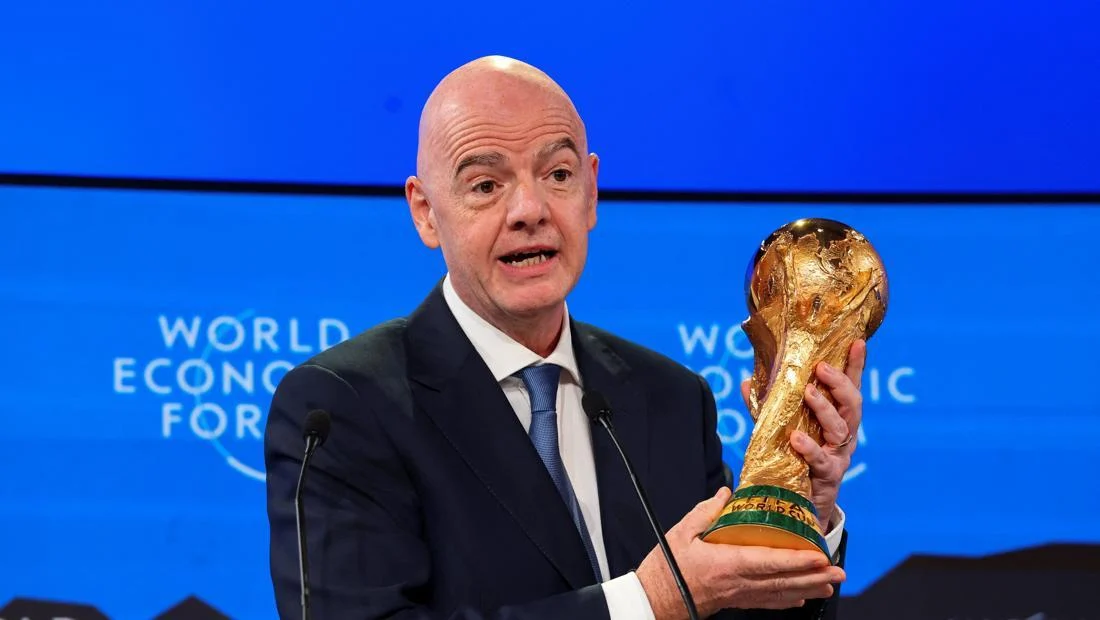
The 2026 FIFA World Cup has long been touted as the most ambitious sporting event in history, spanning three nations—the United States, Canada, and Mexico—and featuring an expanded format of 48 teams competing in 104 matches. However, beyond the spectacle on the pitch, the tournament has also set a record for the sheer scale of executive travel required to oversee such a massive operation. At the center of this logistical whirlwind is FIFA President Gianni Infantino, whose travel schedule during the tournament has redefined the concept of a "global" administrator. According to a comprehensive analysis of flight data, social media records, and official FIFA disclosures, Infantino’s aerial journey during the tournament covered nearly 60,000 miles—approximately 96,500 kilometers—representing a distance equivalent to circling the Earth nearly two and a half times.
This unprecedented level of mobility was facilitated by a Gulfstream G650 private jet, a high-performance aircraft from the Qatari government’s fleet operated by the private charter division of Qatar Airways, a primary sponsor of the tournament. Over the course of the World Cup, Infantino spent more than 100 hours in the air, a figure that underscores the geographical challenges of hosting a modern mega-event across an entire continent. The data, originally analyzed by the Associated Press (AP) and reported via ABC, paints a picture of a presidency that is as much about transcontinental logistics as it is about football governance.
The Infrastructure of an Aerial Marathon
To understand the magnitude of Infantino’s travel, one must look at the technical specifications of the journey. The 100-plus hours spent in the air is the equivalent of more than four full days of flight time. For a commercial passenger, this would be the equivalent of flying from New York to Los Angeles approximately 20 times at normal cruising speeds. The use of the Gulfstream G650, one of the world’s fastest and most advanced business jets, was essential for Infantino to maintain a presence at all 16 host stadiums—a feat he successfully accomplished.
The logistical strategy relied heavily on "executive" or "business" airports to bypass the congestion of major international hubs. While the jet frequently utilized primary airports in host cities, it often pivoted to smaller facilities such as Fulton County Executive Airport in Atlanta and Opa-locka Executive Airport in Miami. These locations allowed for rapid departures and arrivals, enabling the FIFA President to attend matches and meetings with minimal ground delay. Miami’s Hard Rock Stadium emerged as the primary hub for Infantino’s activities, as he attended five matches at that venue alone, often using South Florida as a base of operations for his North American movements.
A Chronological Breakdown of Key Flights
The timeline of Infantino’s travels reveals a grueling schedule that often saw him crossing multiple time zones in a single day. One of the most notable days in this itinerary was June 26. The day began with an early morning flight from Miami to Dallas. After conducting business in Texas, the aircraft headed northwest to Seattle, where Infantino attended the Egypt versus Iran match. Not content with a single-match day, the President departed Seattle late that evening, flying through the night to land back in Miami the following morning to witness the clash between Colombia and Portugal.
Specific flight durations highlighted the vastness of the 2026 host region:
- The Longest Leg: Excluding international travel to and from Qatar, the longest domestic flight was a 344-minute (nearly six-hour) journey from Miami to Seattle on June 15. This flight alone lasted longer than three full football matches played back-to-back. Infantino made this trek to attend the Belgium-Egypt fixture.
- The Shortest Hop: On the other end of the spectrum, the shortest flight—excluding aircraft repositioning—was a 28-minute jump from Seattle to Vancouver on July 6. This "sitcom-length" flight allowed Infantino to transition from an afternoon match in the United States to a scheduled appearance in Canada for the Switzerland versus Colombia game the following day.
The Role of Strategic Sponsorship
The choice of aircraft and its operator is a point of significant interest in the context of FIFA’s corporate relationships. The Gulfstream G650 used by Infantino is part of the Qatar Executive fleet. Qatar Airways has maintained a deep-rooted partnership with FIFA, serving as a top-tier sponsor during the 2022 World Cup in Doha and continuing its prominent role in the 2026 cycle.
From a logistical standpoint, the use of a dedicated state-affiliated jet provided FIFA with a level of flexibility that commercial aviation could not offer. Given the tight windows between matches in cities as far apart as Mexico City and Toronto, the ability to fly on a bespoke schedule was viewed by FIFA officials as a necessity for the President to fulfill his representative duties. However, the reliance on a sponsor-provided jet for such extensive travel also highlights the intertwined nature of global sports governance and corporate interests.
Environmental and Sustainability Implications
The sheer volume of private jet travel has sparked a dialogue regarding the environmental footprint of the 2026 World Cup. FIFA has publicly committed to sustainability goals, aiming to make the tournament a model for "green" sporting events. However, the reality of a three-nation tournament presents an inherent contradiction. While the 2022 World Cup in Qatar was criticized for various reasons, its compact nature meant that fans and officials rarely had to fly between matches. In contrast, the 2026 edition has necessitated a massive increase in carbon emissions due to the vast distances involved.
Industry experts note that a Gulfstream G650 burns approximately 450 to 500 gallons of aviation fuel per hour. Over a 100-hour period, this results in a significant carbon output. While FIFA has pointed toward carbon offset programs and the efficiency of the G650 compared to older models, environmental advocates argue that the precedent set by executive travel contradicts the organization’s broader climate messaging. This tension remains a central theme in the analysis of the tournament’s legacy, as future organizers look to balance global expansion with ecological responsibility.
Official Responses and Justification
While FIFA has not issued a minute-by-minute rebuttal of the travel data, the organization has consistently defended the President’s itinerary as a vital component of the tournament’s success. Sources close to the FIFA leadership emphasize that the 2026 World Cup is not merely a series of football games but a massive diplomatic and commercial undertaking. Infantino’s presence at all 16 venues was intended to signal FIFA’s commitment to every host city and to engage with local organizers, government officials, and heads of state.
"The President’s role involves more than just watching the game from a VIP box," a FIFA spokesperson might argue in the context of such data. "It involves high-level meetings, security briefings, and the management of a multi-billion-dollar operation that spans an entire continent." From FIFA’s perspective, the 60,000 miles traveled are a testament to the "hands-on" leadership style Infantino has adopted since taking office, ensuring that the first-ever 48-team tournament runs smoothly across diverse jurisdictions.
Broader Impact on Future Tournament Planning
The travel patterns of the 2026 World Cup provide a blueprint—and a warning—for future global events. With the 2030 World Cup set to be held across three continents (South America, Africa, and Europe), the logistical demands on FIFA leadership and participating teams will only increase. The 2026 data suggests that the "jet-set" model of administration is now the standard for global sports.
For fans, the implications are equally significant. If the President of FIFA requires a private Gulfstream to navigate the tournament effectively, the challenges for the average supporter traveling on commercial airlines and regional transport are magnified. The 2026 World Cup has forced a reckoning with the "limitless growth" model of sports, asking whether the benefits of a 48-team, tri-national tournament outweigh the logistical and environmental costs.
Conclusion: A Tournament of Unprecedented Scale
As the dust settles on the 2026 World Cup, the statistics of Gianni Infantino’s travel will remain a symbol of the tournament’s immense scale. The 60,000 miles covered in the air reflect a world where football is no longer just a game played on a pitch, but a massive, moving machine of logistics, diplomacy, and corporate synergy. While the Gulfstream G650 provided the speed and luxury necessary to bridge the gaps between Miami, Seattle, Mexico City, and Toronto, it also highlighted the vast distances—both physical and metaphorical—that FIFA must navigate in the modern era.
The legacy of this travel marathon will likely influence how future tournaments are structured. Whether through more localized "pod" systems for teams or a renewed focus on digital governance to reduce the need for constant physical presence, the lessons of 2026 are clear: the world is a large place, and even at Mach 0.925, keeping up with the beautiful game is an exhausting, high-stakes endeavor. For Gianni Infantino, the 2026 World Cup was not just a tournament; it was a 100-hour odyssey that took him to the very edges of the continent and back again, multiple times over.

